Card Games Before the Casino Floor: How Social Settings Shaped Play
Card games before the casino floor moved through homes, taverns, and clubs. Learn how records and specific settings reveal what people played and how.
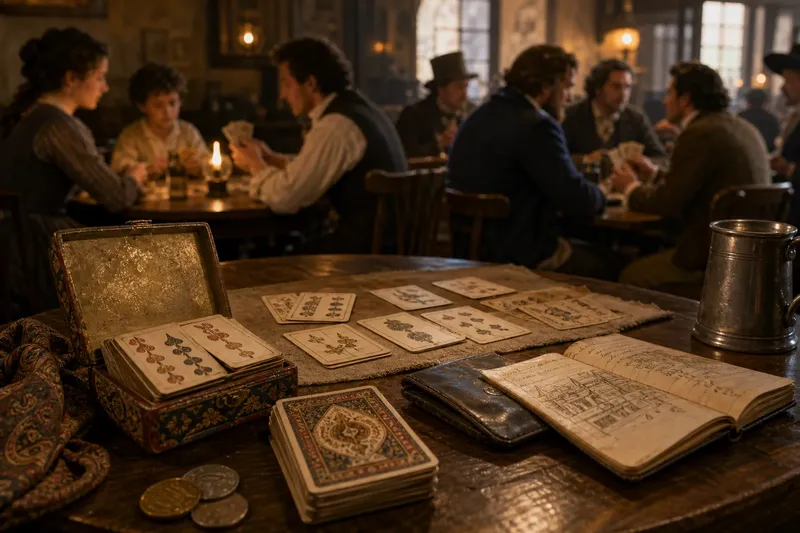
The common mistake in tracing card games before the casino floor is to treat them as one invention that traveled along a clear route. That costs us the practical detail: a household game, a tavern pastime, and a club table could leave very different records. Card games before the casino floor belong to a history of particular places and practices, not one tidy origin story.
Surviving records reveal different parts of card play
A surviving deck can show the cards a maker produced. A dated notice can show that a game or gathering was known in a place by that time. A rulebook can describe how its writer expected a game to proceed. None of these sources, by itself, establishes the full route by which a game spread.
Consider the difference between an object and a description. A deck with distinctive suits tells us about its design, but not how its owner dealt or scored a particular game. A written account may explain a deal while leaving out local variations. When two records use the same game name, compare their stated rules before treating them as the same form of play.
For instance, imagine a researcher has a fictional dated notice naming a card game at a riverside inn, a surviving deck with unfamiliar suits, and a later rulebook that describes a game with the same name. The notice supports the claim that the game was named at that inn; the deck establishes a design, not its connection to the notice; the rulebook records its own procedures. The researcher can report those three findings and leave their relationship unresolved unless another source connects them.
Households passed on games through shared practice
At home, a deck could be brought out during a visit or an evening and used for different games. A new player might watch someone deal, listen to an explanation, then join in. That kind of teaching preserved know-how through repetition rather than through a printed manual.
It also allowed variation. A family could keep a familiar way of scoring or choosing a dealer without writing it down. Such a custom is evidence of how that group played, not proof that every household used the same rule.
Say you are reading a fictional family notebook that describes a trick-taking game. It records the deal and the order of play but says nothing about tied tricks. You can report those recorded details; you cannot supply a tie rule from another version and present it as the family’s practice.
Taverns brought players together for more than gambling
An inn or tavern could host travelers, local regulars, and people meeting for a meal or conversation. Cards might be one activity in a room serving many purposes. Wagers could accompany a game where custom and local law allowed them, but a card game did not have to involve betting, and a tavern was not automatically a casino.
The place matters because it shaped who might sit together and what evidence survives. A public notice or account might name a venue and an activity, while the rules shared among its players went unrecorded. That gap calls for restraint: it does not show that local variations were absent.
When a source names a public house, keep the label it uses and describe what it says happened there. Calling the venue an early casino adds a claim about its purpose and organization that the source may not support.
Clubs and salons attached games to social routines
Card tables in clubs and private salons could sit alongside conversation and visiting. A regular group might have a familiar dealer, partner-selection custom, or order of play. Those details help describe a group’s social life, but they should not be generalized into rules for every player in the region.
Printed accounts can help readers compare a local custom with a published version. They cannot settle the comparison automatically. A book records what its writer chose to include; club members might continue a different routine because it was familiar to them.
Printed rules preserve procedures, not every table custom
Books and periodicals gave writers a way to explain games to readers outside their own circle. A dated edition can help identify what a writer described at a particular time. Still, a rulebook may explain the deal but omit scoring, partnerships, or what happened when play reached an unusual situation.
When comparing accounts, note the title, edition, date, and specific rules each one states. If one source describes the deal and another describes scoring, they may complement each other, but that does not prove that every group combined them. Separate what the texts say from what you infer about actual play.
What do readers ask about card games before the casino floor?
Were card games invented in casinos?
No. Cards were used in domestic and public settings before dedicated gaming rooms became part of casino culture. Casinos organized some forms of play; they did not create card games as a whole.
Did every region use the same deck?
No. Deck designs and suits varied across places and periods. A shared game name alone does not establish identical cards or rules.
How did people learn card games before printed guides?
They could watch, listen, and join games with more experienced players. Repeated play carried local procedures forward, even when those customs left no written record.
Did public card play always involve betting?
No. Wagering was one possible feature, not a requirement of card play. The purpose depended on the people and setting.
Casinos formalized some practices, not the whole history
Dedicated gaming rooms organized certain games in particular ways, but they were one setting among several. Homes, inns, taverns, clubs, and salons each offered different opportunities to play and different chances of leaving a record.
For card games before the casino floor, a sound account keeps those settings distinct. When a history names a birthplace or an early form, check whether it points to a deck, a dated description, or a later retelling. Then state what that source supports—and leave the rest open when the evidence does not connect the pieces.